

The power of connection
Calling November a big month is a bit like calling a zebra a horse-like mammal: descriptive, but far from accurate!
After the craziness of the October conferences - AAPM and RMA, both in Darwin -, the pace increased rather than slowing. Two more conferences (again on the other side of the country for us East-Coasters) and - amidst all the travel, presentations and networking with members and sector stakeholders - simultaneously juggling a whole load of preparations for the GPTA AGM.
I'll pause here to say sorry... I know the very mention of the AGM and all of our calls to action and reminders is making a heap of people cringe right now! What most definitely looked like a crazy volume of similar if not identical communiques and social media posts was in fact a series of strictly timed processes in adherence with Constitution timelines devised back in the pre-digital era when posting notices for members involved Blu-Tac and a few pieces of A4 paper. Once we have all of our members activated on the GPSA Community I can promise we won't be cluttering up your inbox like this.
Around all the online/ virtual member engagement, Simon and I had the joy of connecting face to face with real people - current and new members - in what for GPSA has long been considered a non-traditional space at the 28th Australian & New Zealand Prevocational Medical Education Forum (ANZPMEF). This conference required a return to Darwin less than 2 weeks after RMA, and in those 2 weeks I swear the humidity quadrupled as the "Build-Up" season took hold! Nonethless, the NT showed us five-star hospitality in perfectly air-conditioned comfort at the beautiful Darwin Convention Centre, where we had the chance to discuss how GPSA will work with Regional Training Hubs, universities and Rural Generalist Pathways from across the country to better enable the delivery of high quality training placements across the educational spectrum.
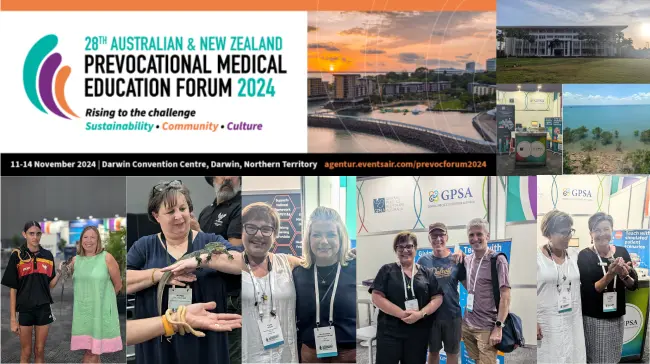
For the second time this year, and for the second year in a row at this particular conference, we joined forces with GPRA to share the exhibition costs at ANZPMEF. A huge shout-out goes to GPRA's Digital Marketing guru, Mylo, for our fabulously branded booth; and to the wonderful woman who was with me as the GPRA representative, none other than former GPEx CEO Christine Cook, who was a hoot - and about as comfortable as me with the reptiles RDAA's Peta Rutherford and ACRRM's Sandra Johanson spent far too many hours cosying up to! Fear of snakes and crocodiles is healthy, am I right?!
Arriving home from Darwin on the red eye flight on the morning of Friday 15th, I had just enough time to throw the washing on before needing to drive a couple of hours up the road to the Deakin University's Supervisor Weekend in rural Victoria. There I was fortunate enough to spend the day with two stalwarts of general practice, Drs Eldon Lyon and Steve Trumble, along with a passionate group of medical sudent supervisors who relished this opportunity to connect with one another and with the Deakin team. GPSA has established a great relationship with this regional training hub after collaborating on our Medical Student Supervisor's Toolbox, and I was delighted to be asked to present on the topic of "Student-Centric Supervison". The discussions we had at tea breaks were, as is typically the case at face to face events, where the real magic happened.
This was true of course at GP24 too, where our choice of gloriusly inviting furniture landed us with the moniker "the VIP lounge" - especially at the Welcome Drinks, with hilarity taking hold on barely a drop of liquor when RVTS' Pat Giddings and team joined GPRA CEO Jo-Anne Chapman on the golden couch!
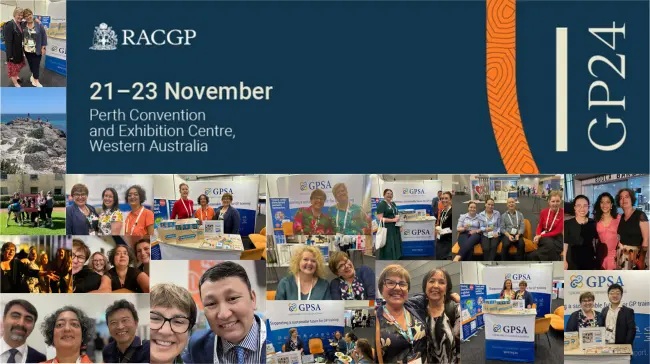
Despite the photos that indicate to the contrary, it wasn't all fun and games at this conference. A big chunk of our small pool of grant funding is invested in our attendance at these events so that we can use the in-person time with members and stakeholders to tease out and attempt to get resolution for brewing issues at the coalface. At this conference one burning topic was the College's Supervisor Professional Development (SPD) requirements, which has been causing a growing sense of frustration and angst amongst AGPT supervisors throughout the year, steadily growing to full-blown panic in recent weeks.
As an organisation with a singular focus on supporting supervisors with best practice educational resources for two decades, it is naturally unpleasant to be advised that our CPD-accredited supervision webinars are not recognised by the RACGP as SPD, but we accept the College's decision to tie their SPD stipend to their own content under the umbrella of their training program. The real issue with this however is that they only acknowledge SPD hours for attendance of sessions run by RACGP's regional teams at times that suit those regional team members, not asynchronously as better suits the bulk of GP supervisors. Then there was the confusion over exactly how many hours an individual supervisor has to attend to satisfy their accreditation requirements - which became a confusion because of the problematic phrasing of the corresponding explanatory document. This has now been remedied with the addition of this clause following our discussions in Perth:
"It should be noted that the SPD hours supported by the stipend is not a requirement for accreditation nor do the estimated SPD hours represent a minimum number of hours for a practice to complete. The requirement for accreditation is that over the three-year accreditation cycle all supervisors in the practice will undertake SPD. The only impact of the practice not completing the estimated SPD hours is that the stipend will be paused."
So, for anyone out there who can relate to the concern one of our rural members had when ther regional team advised that, between him and the only other supervisor in the practice, they had until the end of January to complete 9 hours of RACGP SPD in real-time to meet their accreditation requirements as "specific interest" supervisors, this has been recognised as a miscommunication and has now been amended. We have in the meantime asked for greater clarity about the specific interest SPD requirement which as yet has no number of hours attached to it and is open to interpretation as being satisfied by way of GPSA educational materials and interventions. I look forward to updating you on this point in the next e-newsletter.
If you have read this far into my CEO Blog, I hope you will humour me and read just a little more...
Across all of these conferences in 2024, aside from the SPD kerfuffle, the most troubling issue isn't the RACGP's placement policies (much as they continue to raise the blood pressure of a great many people across the country), but the fact GPs who supervise medical students and prevocational doctors do not readily identify as supervisors, and - unless the supervisor happens to also work in the hospital space and rightly likens their supervision role in general practice to that of a hospital consultant who automatically counts the majority of their working hours as supervising students through to registrars, supervisors of all learners including vocational trainees seem to think of the time they spend supervising in terms of the hours they are paid to teach. The policy flow-on of this flawed self-perception is grossly flawed data at a national level, which is incredibly concerning at a point in time when supervisors and training practices have finally started to gain the recognition of the States and Commonwealth.
So, if you are reading this, I ask you to please help us spread the word and get all GP supervisors - formal and informal, full-time and part-time, practice principals and independent GPs, whether involved with medical students, junior doctors, IMGs, ADF registrars or vocational trainees on any training pathway - to recognise that they are part of a highly respected, essential community of practice, and that every hour they contribute to the development of future GPs and RGs counts as supervision.
And please get them to join GPSA so they can benefit from connection with this awesome community of practice and so we can support them and give each and every member of the supervision community a voice in our advocacy efforts.